
The Broken Mirror
The hunt for a new UN Secretary-General

It takes a special leader to lift the UN above the lowest common denominator of its usually suspicious and fractious membership. I worked for one of the few, Kofi Annan, who managed it. Most don’t. I use the metaphor of the UN as a mirror held up to the world; and when the world is fractured or even shattered, so is the mirror.
This month has provided me plenty of grist to reflect on whether the UN has entered the terminal decline that afflicted the League of Nations in the 1930s. A draft manuscript of an excellent new book on the League, Ghost in Geneva by Michael Manulak, provided a rich seam of historical comparisons. The decline, for example, started well before Italy invaded Ethiopia and involved League climb downs over Corfu and Manchuria that set the precedent for the League’s passivity over Mussolini’s shameless Ethiopian act of late imperialism. The British Foreign Office, never convinced that a new rule-based order could replace the old one based on balance of power, bluntly prioritised keeping Italy and Japan out of the arms of Germany. This took precendence over the League’s commitment to rights and justice because that’s what you do in a balance of power system. You keep enough countries on your side - whatever the moral cost - to deter the other guy.
State of Play
The first wave of candidates to be the next UN Secretary-General (SG) took to the road this month and a number appeared at hustings in London, where I was part of a warm-up act, and Geneva.

Several of the candidates notched up solid performances but none electrified their audiences and a sense remained that other candidates were still hiding in the wings. But equally there was a suspicion that those skulking offstage are not necessarily the visionaries who might rescue the organisation but the back-pocket candidates of the P3 - the US, China and Russia - whose support is necessary for a candidate to succeed. A choice needs to be made over the next months to allow a new SG to take office on 1 January, 2027.

Macky Sall in New York
Over this month also, I have participated as co-host in recording an eight part podcast series, World’s Toughest Job for Foreign Policy and the UN Foundation. Under the probing guidance of our excellent host Jasmin Bauomy, each episode combines a rich archival example of UN Secretary-Generals rising to a challenge - such as peacemaking, climate negotiations, development or simple leadership - followed by a panel discussion about future challenges and then my closing thoughts.
So where does my month of multilateral immersion leave me?
6 Key Points
First, that this election matters. It probably is a last ditch chance to revive the UN and restore its legitimacy and authority which is currently hanging by a thread after a terrible decade for the organisation. Notably because two of its founding members, Russia and the US have strayed from any pretence that their imperialistic ambitions comport with the UN Charter. This has swung the world back towards an older pre-1919 disorder, Balance of Power politics. It makes a new Secretary-General both the standard bearer for that currently-vanishing 1945 vision of a rules-based order but also, without armies of her or his own, someone who must nevertheless keep channels open to the UN’s founding, now rogue, backers. Above all, they must be a persuader. The SG must juggle the roles of principled and loud campaigner for collective solutions to the world’s problems with the role of diplomat who talks to all, even the villains of the new disorder. One moment they will be wearing the boots of the activist, next the dancing shoes of the mediator.
Second, in the podcast Prince Zeid, the former UN High Commissioner for Human Rights, lamented that the selection process did not allow a balanced panel of the wise and the good to go search the world for the best candidate. He wanted to keep the process free of the normal political horse trading. It sounded a bit like how a new Dalai Llama is chosen! Although the latter lacks a temporal CV as they are chosen at birth!
My preferred example from another religion, the Catholic Church, is barely more realistic - but the sharp and mature political calculations about candidate positioning, communication skills, and management competence that allowed the quick selection of Pope Leo in closed conclave at the Vatican might in other times be an inspiration to the UN ambassadors exercising this vote - above all to put the institution and its mission ahead of national interests. Little chance, I fear.
Third, what can be done to open up the race; make sure the candidate field is as strong as it can be and that the best candidate wins. The formal process, laid out in the Charter, is that the successful SG must secure 9 votes out of the 15 council votes and must not be vetoed by any of the 5 permanent members. The successful candidate is then presented to the General Assembly for confirmation - until now, no more than a polite affirmation of the Security Council choice. In a UN where legitimacy is swinging from the deadlocked Security Council to the General Assembly, one level of protection of the process would be that a P3-sponsored candidate is rejected by the General Assembly (GA). While floated privately by some senior GA figures, it seems unlikely that the GA would combine on such a poke in the eye to Big Powers. More plausible is that the elected members of the Council, the so-called E10, sit on their hands and do not give a P3 candidate a winning majority, but here too arm-twisting by the P3 makes it look a frail defence. And yet a candidate who is not the General of the other 190 members but rather the Secretary of the P3 is bound to fail. They will lack the authority of the many and be under the thumb of the very few.
So fourth, the one manoeuvre that might work is that the British and French stand up now and declare that as the other two veto holding powers they will not let a candidate through who:
does not enjoy widespread support in the General Assembly; and,
has not exposed themselves to sufficient public scrutiny in the GA hearings and through global town halls and media appearances.
No last minute stealth candidate produced out of a Mar-a-Lago hat. Various dubious Palm Beach socialites are rumoured.
As the votes are conducted in the Council by an informal straw voting system it would not require either formally to deploy their veto, which they are properly reluctant to do given its increasingly anachronistic associations.
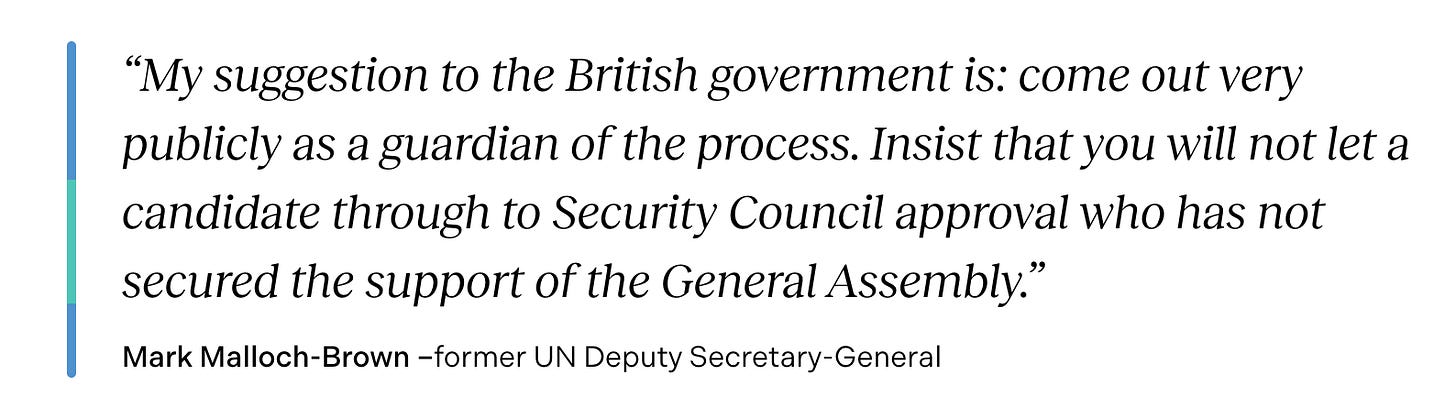
London - On 28 May, UNA-UK hosted a landmark public husting at Methodist Central Hall Westminster—the site of the first UN General Assembly meeting 80 years ago—bringing together candidates vying to succeed António Guterres as the tenth Secretary-General of the United Nations. But a necessary ingredient - political courage- is not very evident in either capital. Until this week, at least, French diplomacy has been reduced to a hospitality objective- making sure Donald Trump came to Macron’s G7 summit and stayed until the end; that meant no provocations. Now perhaps the French can worry again about the world, not the place settings.
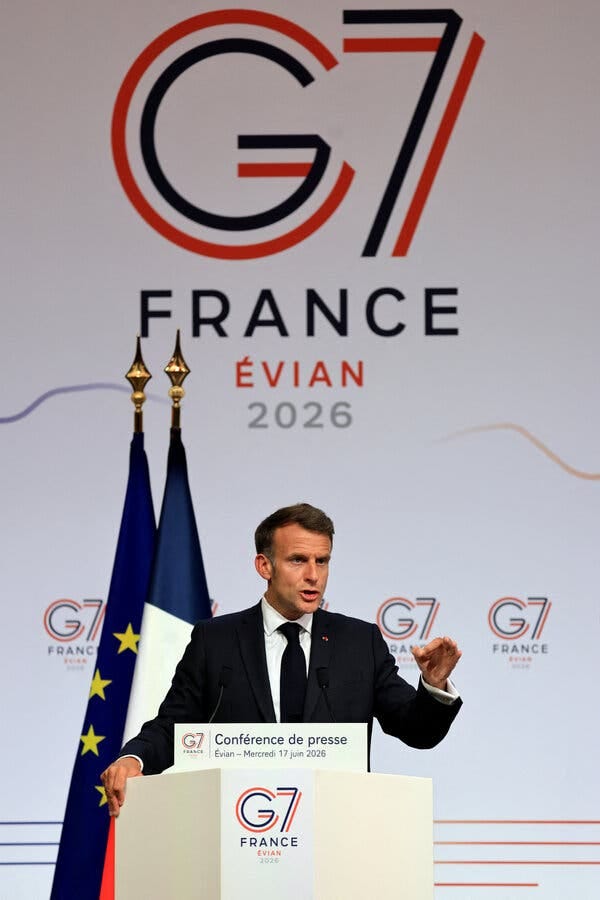
© NYTimes And British ministers are completely missing in action as that government melts down. Officials, not ministers, are therefore in charge and they remain instinctively - or sentimentally, pick your term - Atlanticist, not wishing to add to the list of US grievances with the UK, which currently spans from Iran to defence spending. So, other UN diplomats view them as bobbing along in the American wake rather than helping open up fuller General Assembly involvement. In fact, the choice of a UN Secretary-General cannot be high on Trump’s priorities or flash points. For him it’s no more than a world stage with a captive audience to behave badly on once a year in September at the opening of the General Assembly. The British could well afford to add one more to his list of complaints about them at little real cost. And UK officials might reflect on how their predecessors’ bloody hands were all over the knife that slayed the League1. Will they repeat the crime?


Fifth, a genuine rogue card in all of this is China. A very different Nationalist China was betrayed by the League over Manchuria2, when the latter accepted Japan’s fake-news version of the facts as justifying intervention. And once Mao’s China finally took its seat, the UN has provided a vital platform of influence for China.
Further, the rule-based global order allowed China to get rich long before it could project the military power to protect its trading routes. In a rule-based world that spawned globalisation, they were safe on their own as a global mercantilist with a puny military. China has done very well out of the UN and its comments about this SG election have been appropriately moderate as a consequence. China refers to its spirit of sino-multilateralism as ‘true multilateralism.3’ It’s Foreign Minister has acknowledged, for example, that ideally it is Latin America’s turn to produce a candidate- and preferably a woman. So China is a greater respecter of UN convention than its norm-busting peers, the US and Russia, but hardly likely - given the character of its own politics - to embrace as SG a champion of human rights, or one who makes uncomfortable arguments about conflict prevention.
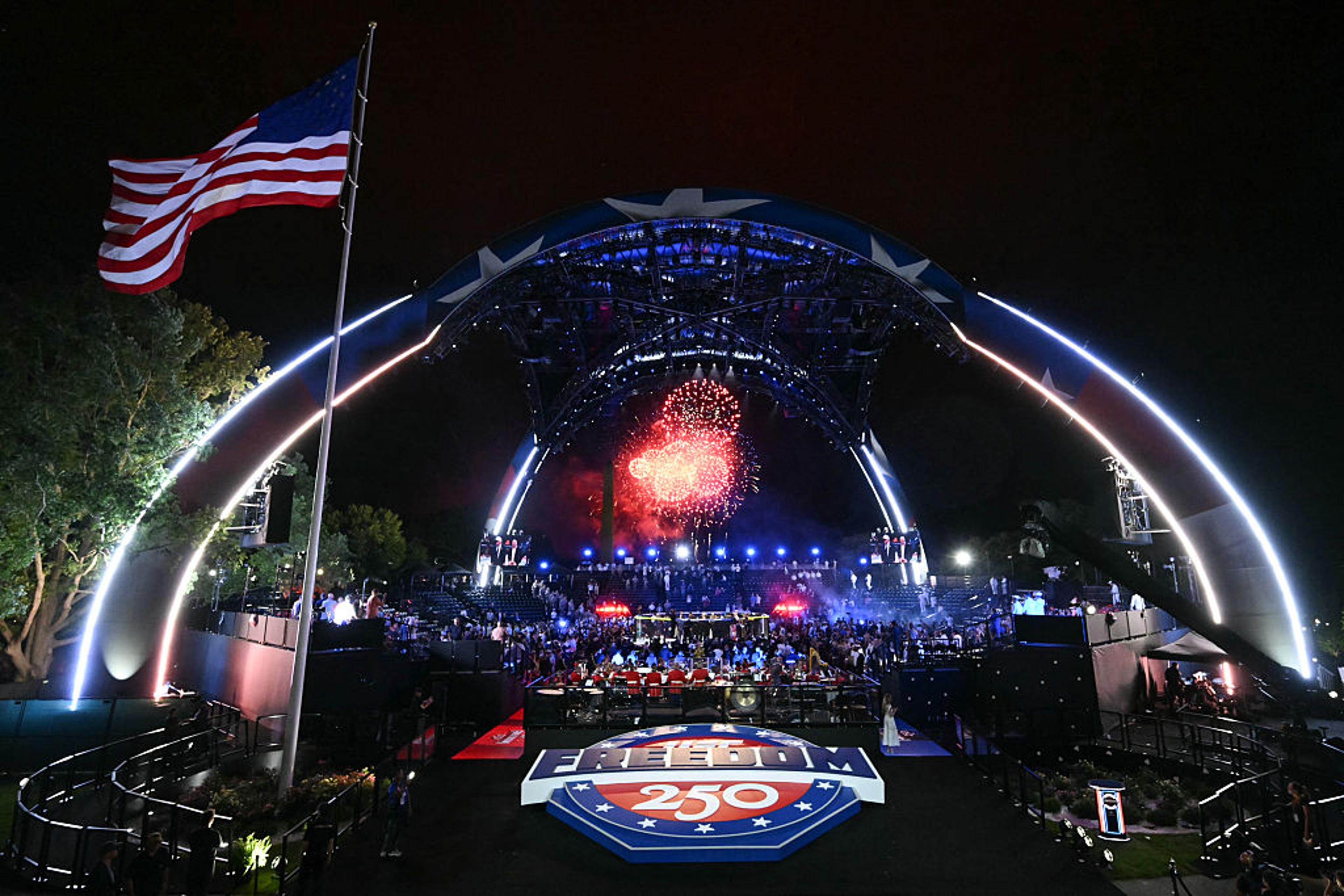
Sixth, the ambition to have a woman Secretary-General surged ten years ago but was thwarted4. The champions of it this time5 are being careful in framing the case in a way that would not set off Trump, with his hatred of anything that seems to deliberately tilt the world against white men. Yet writing against the backdrop of Trump’s masculinity-celebrating cage fights staged on the White House Lawn, his failed war in Iran, and its flawed ceasefire (all largely men-made spectacles and mishaps), it does seem that Trump is in this regard at least a woman’s best friend. A little compassion and respect, together with a patient attention to detail when it comes to peacemaking, would not go amiss amidst the chaotic and violent testosterone-charged world he and Putin so relish.
Trump boasted on Truth Social the night was “PERFECT!” - the AP
General of the GA
The reason so much rests on this SG choice is not just a frantic grasping for good leadership - often a mirage if the decks are stacked against it - but more an emerging certainty that the UN has to chart a path to new ownership if it is to survive as a useful institution. With a broken Security Council, the Secretary-General becomes a critical potential helmsman in navigating this shift.
I saw from my own time at Kofi Annan’s side that a Secretary-General has a unique platform to find common ground, edge diplomatic processes forward, and convene eclectic parties whether on security, public health or climate. But Annan had an advantage that this successor will not have - strong support from Big Powers and when even he lost that over Iraq, his diplomatic authority was significantly reduced.

A new chief will have to create a new evolving and shifting bench of substitutes to make up for the American and Russian semi-absence. There are plenty of countries from regional powers such as Brazil or India to smaller countries that hold on to the centrality of the UN6 in how we organise ourselves. They have no appetite for trading in a rule-based system for the current descent back into a pre-League world.
Yet it will not be a heroic return to rules with a happy ending. The script gets written in the messy reality of politics, not in Hollywood. The tension between realist national interests and the aspirations of a world run by the UN rule book will remain a live one. Regional powers are every bit as capable of double standards when it comes to protecting their local standing as global ones.

May the best system win
What is striking about the League of Nations is both systems, realist vs an universal rules-based system, jostled for influence inside the League. A small number of visionary politicians pressed for the full League ambition. Their efforts centred on the Disarmament Conference, the brainchild of UK Labour leaders, whereas the realists stuck back with the Locarno Pact. The Pact was initially intended to stabilise European western borders but then became essentially a concert of bigger powers that met privately in advance to put the fix in on key League decisions. Whereas the disarmament effort, despite great hopes, fell apart as Germany demanded the right to rearm to achieve parity with a suspicious France; the British objections to naval reductions added to the inevitable failure. Countries concluded, as the war clouds gathered, that they had to hide behind arms not laws.
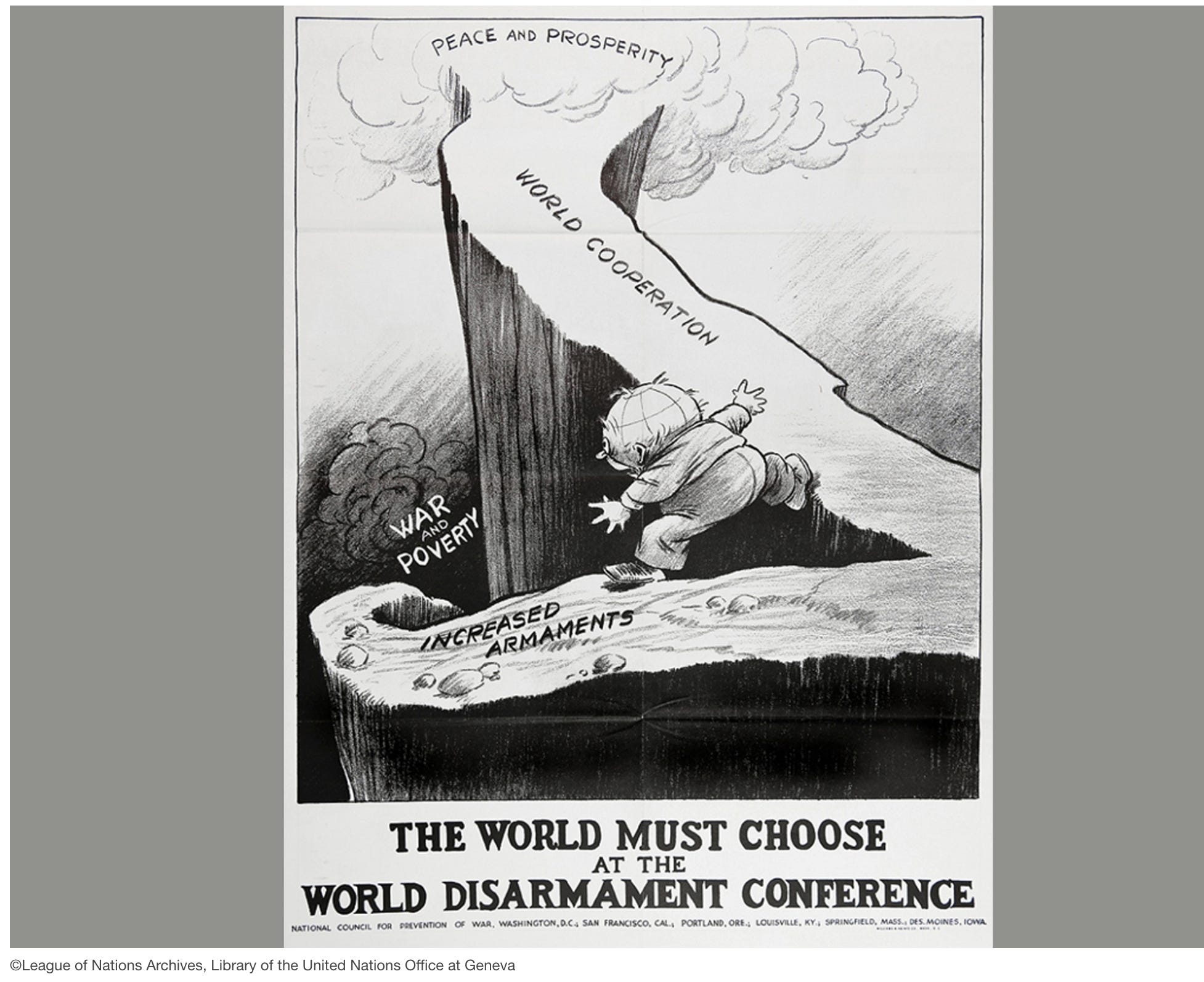
The world was limbering up for another war. The Thucydides trap of rising powers and falling ones was on full display. The idealism of the League, even the memory of a devastating World War, was no match. Countries had reverted to taking sides.
The question is whether this time around rival systems and visions of how the world should be organised can be contained within a UN framework. Again, the realists are on the rampage but so far they are not succeeding. Putin is not winning his war in Ukraine; nor Trump his in Iran. And the realists brought down the League but failed to keep the peace when Hitler invaded Rhineland in 1936 and revoked the treaty.
Learned our lesson?
Let’s hope it doesn’t take another such conflict to make leaders recognise the limits of realism as an operating doctrine. Our globalised world is already too connected — trade and economies are too interlinked, modern choke points like the Gulf of Hormuz too critical, the impact of coming climate change too imminent, the impact of forces such as demography and AI on the quality and global location of work — for the world to waste too long on this re-run of a pre-modern system. It should be consigned to the cage fight and the history books.

The bloody noses the Big Powers are getting may make Trump and Putin’s successors think twice before putting all their eggs in the realist basket. There may be a modest swing back to a more engaged multilateralism as they recognise the limits of conventional force and power in an age of asymmetric, fast-changing warfare and shifts in economic standing. Yet the Thucydides logic will remain.
Both powers are losing ground to China and now others. The temptation to try and hold back the future via a desperate realism will vie with the commercial and economic need for a more orderly stable world. A UN Secretary-General will be a key figure managing these epic shifts, not least as these old men are shuffled from the stage.
Seeking World’s Secular Pope: mediator, storyteller, strategist & manager
My own ringside view of the SG job is that it combines the infinite patience of the mediator - repeated phone calls and travel7 - as the the two sides are inched forward to a peace agreement, with the long-term vision of a storyteller and strategist, who can seize on problems like climate change, assemble the right actors, and develop a convincing narrative about the possibilities of long-term change.
And there is the ever present challenge of management; never enough resources; and of preventing the permanent temptation of the bureaucracy to slip into never ending processes. In a forthcoming episode of our podcast, Sigrid Kaag and Martin Griffiths, two of the most successful UN officials and mediators of recent years, argued that despite the overwhelming agenda they will face, a new Secretary-General might initially do better to take challenges head on through a small, loyal but talented team, immediately around them, rather than by trying immediately to re-animate the wider bureaucracy. The latter is so incentivised to descend behind the ramparts of that bureaucratic process as a means of demonstrating even-handedness to a watchful state membership that staff can often become detached from their raison d’être: impact and results.
There was a reason we called the podcast World’s Toughest Job. It’s a pity Pope Leo doesn’t have a sister.
Best,
Mark
—
With assistance from Eilis Klein
—
Further reading
Endearing American sports stories are doing A LOT to buoy America’s reputation:
New York - a British take on Knicks in 5
Boston/ Scots - American impressed by Scots’ cleanliness to inebriated ratio
Kansas/Algeria - Midwesterner serves as proof positive of ‘Midwestern nice’
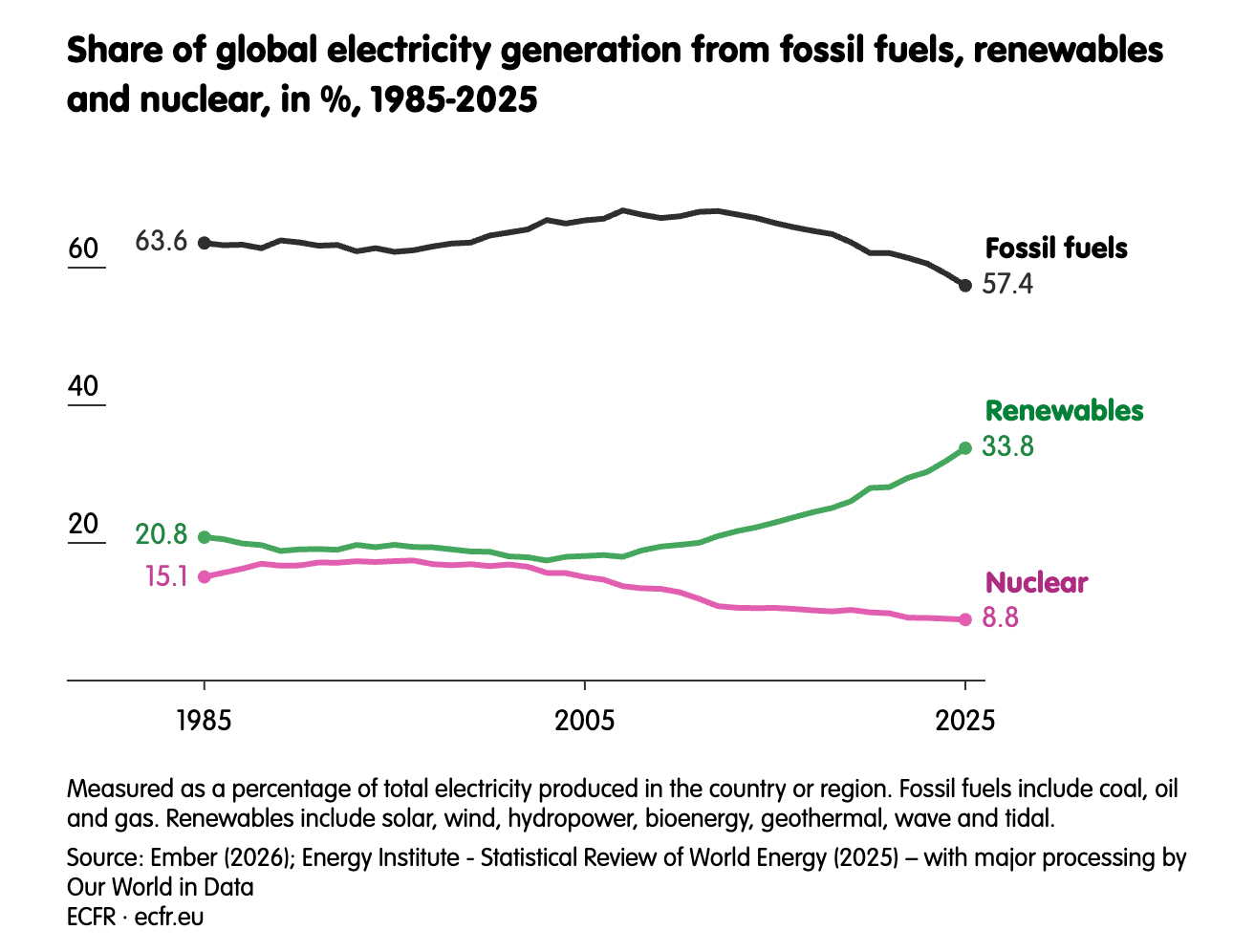
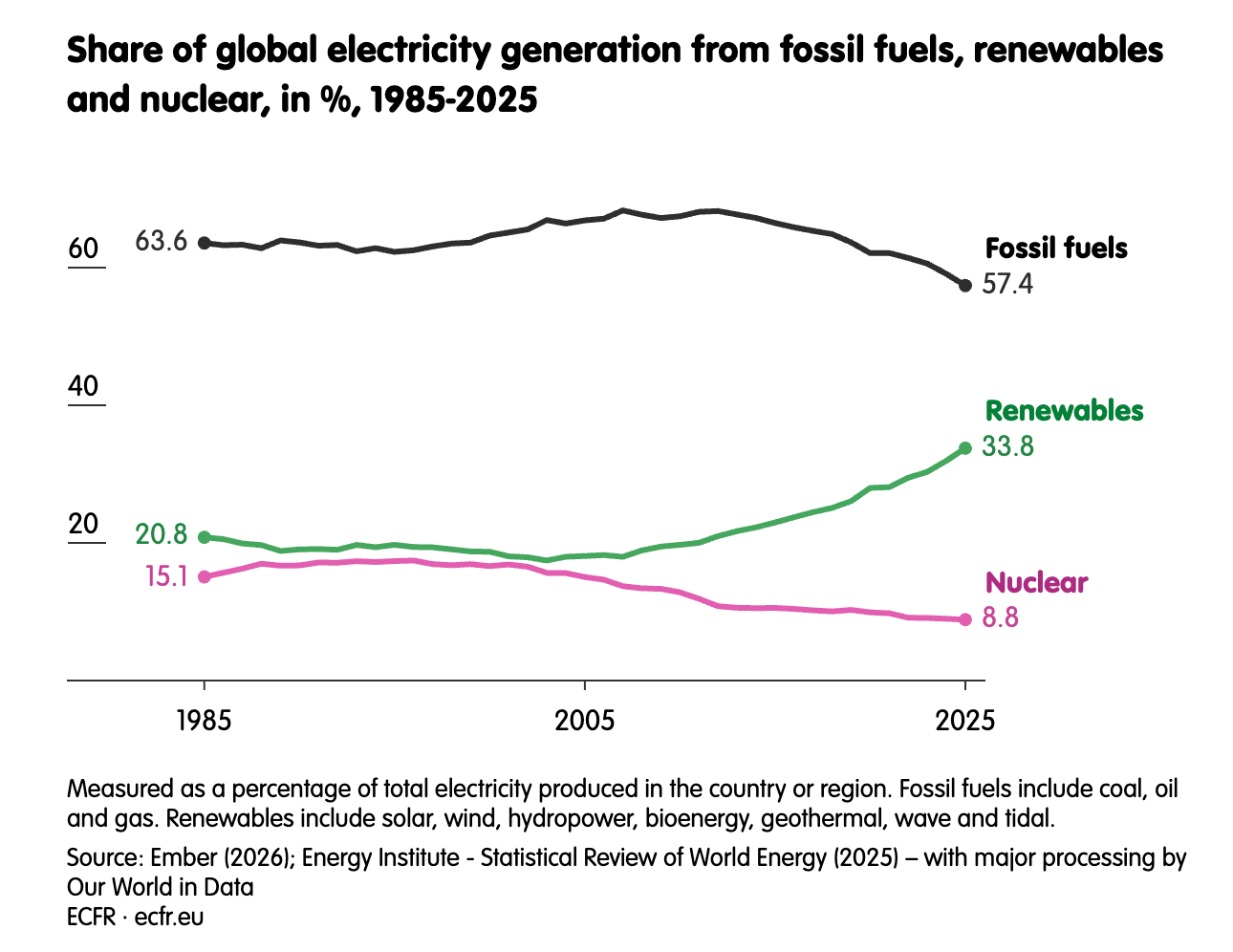
New from ECFR | The new climate battle: Five deals to recharge the green transition
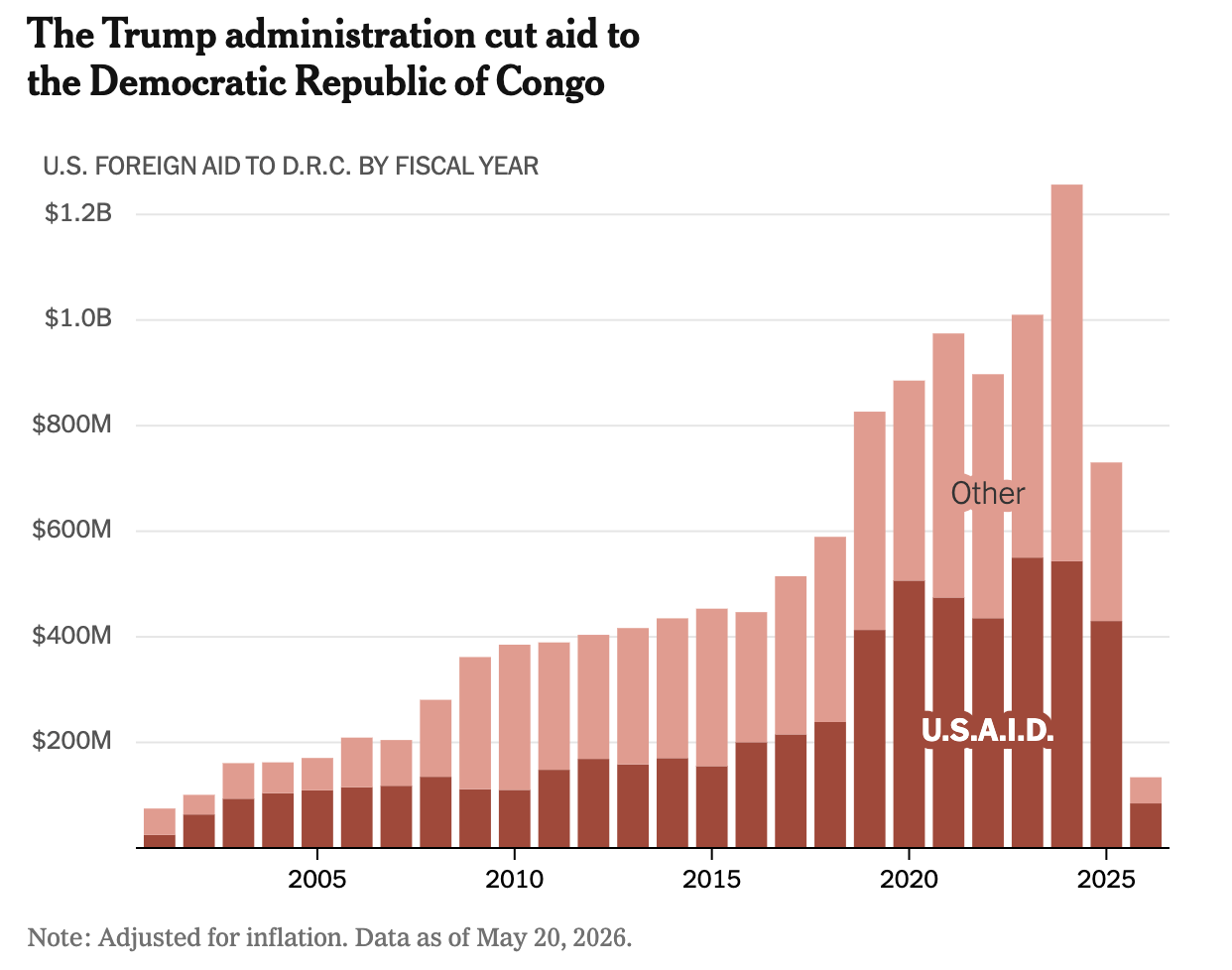
Jeremy Konyndyk: “This Could Be the Worst Ebola Outbreak in History”

“The League failed to intervene following the occupation of Manchuria in 1931 and the invasion of Abyssinia (Ethiopia) by Italy in 1935. This not only affected the political credibility of the League, but also marked the collapse of the collective security system.” - UN Geneva
Coverage from the Times Machine
Including, but not limited to, 1 for 8 billion
Small states make the best multilateralists!
Sorry, one more?
Do you see any scenario where a Uniting for Peace Res can lead to the establishment of such a trust?
Michael Manulak, who co-wrote a paper titled "A UN Trusteeship for Palestine", in early '24, I believe. Would you sir be willing to offer a few words on why such a proposition cannot get the slightest traction, despite it's unique potential for remedying so much that ails us?
Perhaps a comparison with the BoP would be instructive. Thank you!