
Soft Power, Hard Landings

The US administration has set about trashing America’s overseas development assistance (ODA) and when its vandals rolled up they found the house wasn’t locked. What makes this such a dangerous moment is Trump’s keen sense of where opportunity for destroying the old order lies. He has an eagle eye for where pre-existing weakness lies. Aid is a good example. It was already at risk before he launched his bazooka. Now it is in free fall.
Following a Trump Executive Order, the Voice of America and its sister channels, America’s global public radio network, have largely fallen silent or are playing music rather than reporting the news. In the day, when the state broadcaster started to play music it usually indicated that a coup was in progress.
President Trump has suspended the stations as part of a much wider assault on American soft power. The most striking include the dismantling of USAID, the literal occupation and seizure of the US Institute for Peace and the US-Africa Development Foundation, and a 180 day review of international organisations. This has led to a questionnaire to many UN agencies asking them to justify themselves against criteria that include: what have they done to make America safer; to improve the US economy; and to make the country great again. Further questions explore these agencies’ commitment to diversity, equity, and inclusion (DEI). Together, these questions seem to provide a loyalty test that organisations that serve 193 countries will have difficulty meeting. Already large numbers of staff are being let go. In the UN’s corridors there is muttering of an institutional McCarthyism, recalling a time when the US imposed an anti-communist loyalty test on American staff at the UN.

The singling out by President Trump of individual judges as ripe for impeachment for just doing their job of upholding the law; or the denigration of public sector officials such as Samantha Power, the Biden head of USAID, or Michael Abramowitz, the director of Voice of America, as leftwing crooks and subversives suggests a personalised McCarthyism not just an institutionally targeted one. Samantha is an Irish immigrant who came to America with her mother and Mike the second generation of a family devoted to government and service. Both are longtime friends of mine and I can attest are the among the best exemplars of an American dream of making a difference and giving back to the world. An ethic we are seeing blown up in front of us. There is little sympathy or patience in the MAGA heartlands for such values or people. They are tarred as deep state criminals and Washington has so lost its way the charge sticks. I suspect it won't help either of their cases to say I first met Samantha when she was interning in the office of Mike’s father Mort Abramowitz when he was the president of the Carnegie Endowment. Further evidence no doubt of deep state ties!
This is not just a Washington earthquake. Quite apart from the free fall in US international standing that these actions have generated there are wider consequences. Is the international system answerable to one owner or the other 192 as well? Second, is there a future for development assistance (ODA) when the world’s largest provider has made clear its intentions to end most of its provision? The dismantling of the American postwar system and pursuit of the people who ran it is a story that is going to run and run. But what it means for development and international co-operation is not a bad place to start.
Partly this is to acknowledge that what starts in Washington doesn’t stay in Washington and it’s also to recognise that Trump and Musk had a public opinion rich target in attacking ODA. The US is not alone other than in the abruptness and malice of the cuts. And hence my opening point about Trump and Musk knowing how to find open doors to kick in.
As tragically, Europeans have cut too, including France, Switzerland, Sweden, the Netherlands, and very dramatically the UK. For the most part they have expressed regret blaming it on budgetary pressures along with the hope that they might reverse the cuts in due course. The UK, as the latest to cut, has explicitly laid it at the door of the increased defence spending necessary as Trump’s America signals a pullback from Europe. They have also tried in some cases, unlike the US, to give recipients notice. The UK for example has signalled the reductions early and allowed a two-year phasing down. Yet with no alternative donors in sight this is arguably merely a death sentence delayed.
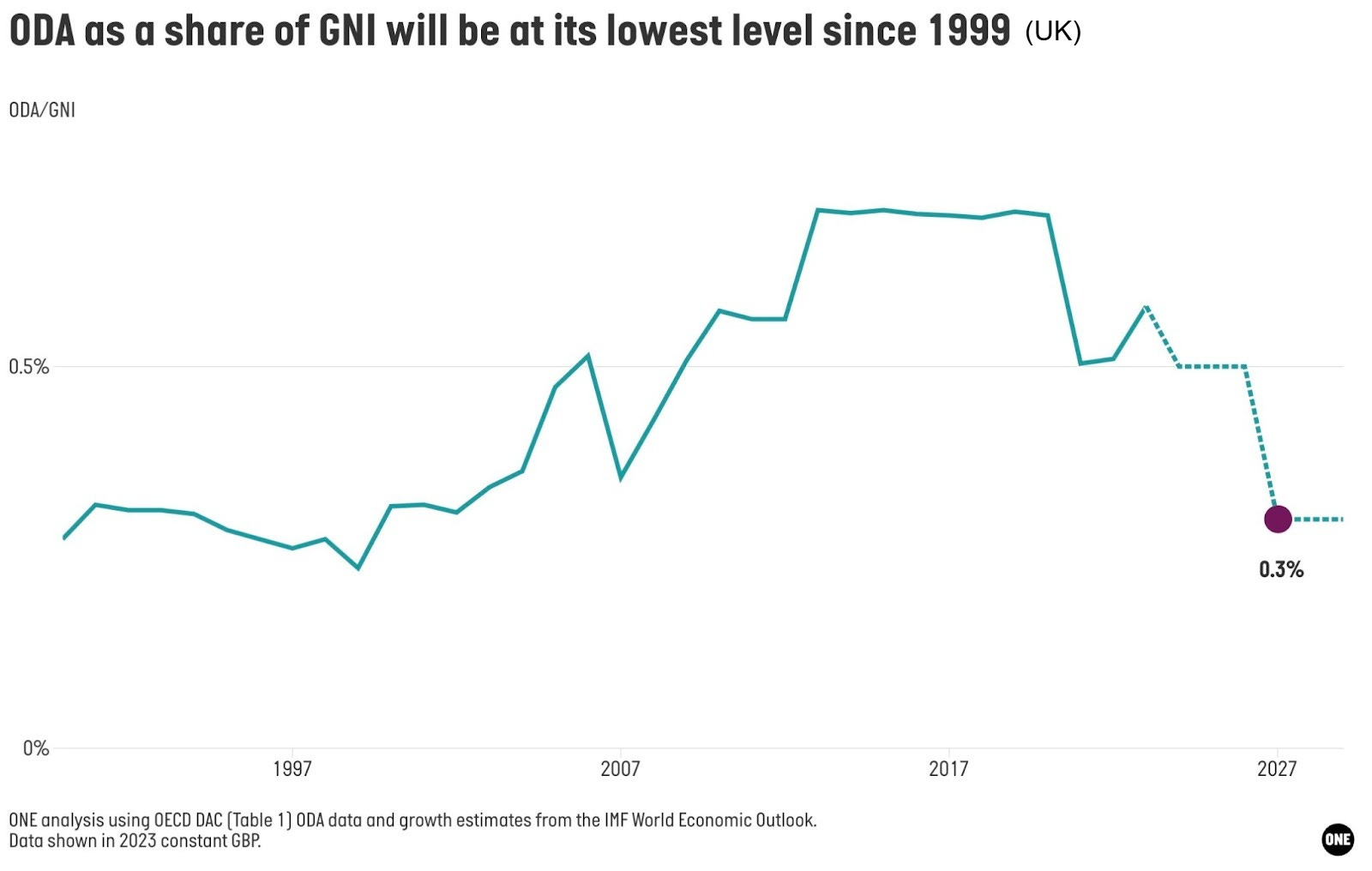
Odourous ODA
The tragedy is that over a quarter of century from the 1990s, development outcomes in terms of poverty reduction, life expectancy and health, and educational enrollment improved more rapidly than at any time in world history. And climate change was slowed. ODA was part of this success. Looking forward there are challenges in both development and climate which still need large amounts of grant support and it is a tragedy that they seem unlikely to get it but what can be salvaged is a system of long term lending.

Here, despite this bleak picture, I suspect there remains a real future for strong, international public financial flows to support development and contain climate change. It’s just not going to be branded as aid or ODA. So in future not grants but concessional loans. And that has real limitations as Mia Mottley, the prime minister of hurricane-prone Barbados, and others have argued. Natural disasters such as floods or earthquakes take away economic capacity so repairing the damage on loan rather than grant terms is a real burden on the recipient.
One glimmer of light is that ODA will stay put for the rising number of humanitarian disasters - a consequence of changing climate and security breakdowns. Annually it swallows a bigger portion of the ODA that’s left. But, hopefully there will be enough to also support the 25 or so poorest and most fragile states where loans would only increase indebtedness. A leaked memo suggests a re-launched scaled back US program might indeed be centred on humanitarian assistance with the rest going into the kind of private sector lending guarantees and blended finance that are clearly going to be a major part of the future financing architecture.
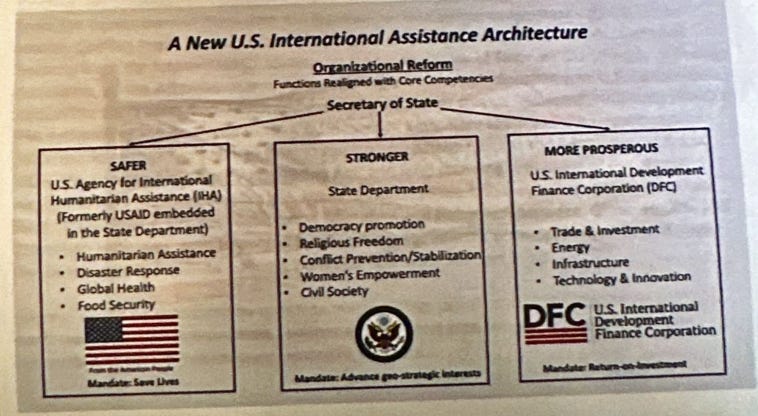
But ODA - rich countries “giving” to poorer ones - has evidently peaked after a quarter of century of growth and success. Everywhere domestic spending priorities are crowding it out. On the right, it has long been labelled a welfare programme for corrupt elites in third world countries paid for by the blue-collar tax payers of the world’s donor nations. On the left, there has been a growing unease about its paternalistic or colonial character. In developing countries, there have also been frustrations. First, the demand that ODA should be elevated to a right not a gift and be enshrined as a reparation for either colonial occupation or climate damage (or both). That seems less probable than ever. And second that assistance should be set at much more significant and predictable multi-year levels and that the sourcing should be much simpler. At present every international conference seems to end with a new fund so as to placate the demands of developing countries. The new vehicle is then left largely empty by donors because they are not increasing their total funding just fragmenting it across more outlets. For a recipient, navigating this is made ever harder- more sources to chase and each with their own rules and requirements.
It's just not reliable funding. The last point is demonstrated by Trump’s abrupt USAID closure. Life-saving programs got shuttered overnight. The Center for Global Development calculates that an estimated 3.3m lives a year were probably saved annually by USAID programs. Now many of them will be in immediate jeopardy. The two biggest casualties will be the public health and food security programs which were big in scale and vital lifelines.

But many programs could have been a lot more efficient if they had been blended into a single all donor country strategy. They would sit neatly beside World Bank, UN and other bilateral flows in a single coherent programme that reflected clear, national priorities and built up national (as against donor) delivery capacity. Instead too many programs are often an incoherent set of projects reflecting donor, not recipient, preferences. In USAID’s particular case, congressional earmarking has been a particular bugbear, reflecting home town voter priorities - such as shipping out midwestern farmers’ grain surpluses, a long running sore of the aid system.
Towards post-ODA Finance
So why given this wholesale assault will financial flows for development not slow even if they change in character and origin? The case begins with the obvious. They are still needed. Bluntly, the strategic costs of allowing a large portion of the world to fall further behind in terms of security, illegal migration flows, the limiting of potential global economic growth, unmanaged climate change makes an abandonment of financial assistance flows unlikely - although not impossible.
Further, as many emerging market countries reach a stage where they should be improving domestic revenue through higher taxes, rather than relying on aid flows, the whole categorisation of the world into rich donors and a poor Global South looks absurdly simplistic. In truth the big Asian economies are racing ahead in any world league table of national income. They will pay for their own development - and largely already do.

Perhaps the more important question is what kind of global political order might underpin such flows in future by providing a new rationale. The first possibility is a world of empires where literal territorial expansion (think Canada, Ukraine or Taiwan) is accompanied by new much larger spheres of influence; shadow empires so to speak.
Donald Trump’s apparent aspirations for a modern Yalta where three global powers - US, Russia, and China - would divide the world up into spheres of influence and would almost certainly usher back an era of old fashioned aid-for-influence. The Cold War most recently saw not just an arms race but also an aid and soft power race between the US and the Soviet Union. Countries were cultivated with financial largesse, scholarships, a flow of media and cultural seduction from the Moscow and Washington rivals. Soft power was as much a tool as its hard power sibling: security assistance. Any return to such a big power world will quickly reintroduce a demand for soft power as the three rivals angle for influence in a new age of rivalries.
Ironically, a Trump Administration would likely find itself reviving not just an aid agency but an official global broadcaster, an Institute of Peace like think tank network and other soft power institutions. This as it competes to hold onto allies against China’s Belt and Road Initiative that finances recipient countries’ infrastructure, Russia’s RT broadcaster, and China’s international Confucius Institutes. Empires cost, and not just the hard power part. Ironically it could even be the best bet for an ODA revival as America finds itself doling out grant money again to hold onto friends.

The difficulty is Cold War aid was highly inefficient and corrupt precisely because its primary purpose was to win and keep friends. So its benefits flowed to corrupt elites, not the poor. And too often drawn into it were the multilateral institutions. Most were heavily US and Western dominated. The Bretton Woods Institutions, located in Washington, and leveraging a capital structure of Western governmental guarantees, which allowed the US to secure major loan allocations to allies, were particularly vulnerable to becoming in all-but-name an extension of US economic foreign policy. When I worked for the World Bank in the 1990s, we were still unwinding the financial and reputational consequences of lending to American-backed dictators in Africa, Latin America, and Asia where the monies had too often gone to ruling family enrichment - not development.
The other path is one where a much broader set of nations steps up and seeks to work around this emerging new super power constellation. This coalition of the willing would support a new development compact, based on governments putting their collective guarantee behind long-term affordable loans that allow poor countries long-term predictable borrowing against agreed national development strategies. This imagines a single, largely unified funding channel through multilateral partners rather than the existing fragmented bilateral channels. With the current cuts only Germany retains an aid program, at $38 billion, of sufficient size to be able to make a respectable, as against flag-waving, case for retaining its bilateral character (for now - as it may be the next to cut in order to pay for defence spending increases) .

Rally Around This Flag
More important though than the efficiency point is the re-positioning of ODA away from its past as conscience money or tool of influence to a new contract of equals between donors and recipients, where mutual accountabilities are spelt out, and the burden shared for moving a shared planet forward through the multiple collective challenges posed by development, climate and technology change. By changing the financial nature from aid to loans, in other words a development banking model, not aid agency grant, the relationship as a whole can be reset from one of dependency and its ugly history to a businesslike one of equals. The platform for this would be the already extensive network of development banks at the global, regional and national levels. The World Bank is just the most well known.
Core to this new model is an overdue switch from programs designed out of Washington and other Western capitals to locally designed and owned strategies. There is a growing recognition that imposed strategies don’t work. Countries must choose their own path and own it. Showing the way is the NGO sector for which the mantra in recent years has been the ungainly word, localisation. This recognises that Western-led disaster and development response must be replaced by one where local capacity is built up. Locals and their own organisations must lead. Related to this has been a big push by new-ish organisations like Ground Truth to opinion test beneficiaries and affected communities so that their voice is also represented in the design. Sometimes a developing country capital city is as detached from conditions on the ground as an international donor agency.
And there is a powerful alternative political rationale to that of empires of influence for such a co-operative partnership-based financing system. It’s the anti-empire stance that we are starting to see play out in the revival of the political fortunes of the ruling Liberal party in Canada and its new leader Mark Carney (up 25% in the polls in a matter of weeks) or in the position of the new German chancellor-to-be, Friedrich Merz. They are anti-Trump and anti-Putin and want to keep their countries and the world free of over-reaching autocrats.
Soft power is a key to keeping the world an open system, as against the closed one of the first path, and multilateralism becomes the solidarity against big power dominance. The likely recruits, from Europe to southern middle and smaller powers, for such an alternative system are large in number.
At a far from negligible cost - more expensive money - it allows development and climate finance to be freed from the political dead weight of the “aid” name and to be reset in terms that both lenders and borrowers can be portrayed to their citizens as winners; for lending countries they are paid back and for the borrowers they are masters of their own development. It is not a panacea and will be accompanied by its share of debt crises and lot of angst about the natural justice (or lack thereof) of loans rather than grants but I suspect given the politics it is where we are headed. It is a means of putting locks back on the development assistance doors, and politically weather proofing them, to return to my opening.
The New Cold War- Open versus Closed Worlds
Loans or grants we are in for a period of contestation between the closed and open alternatives - Yalta versus the rest. The real rivalry of the US and China, now expanded by a Trumped up Russia, economically weak and dependent on China, is likely to be inherently unstable as both sides pile on soft as well as hard power cards in their attempt to prevail. But it will have its supporters where other strongmen are rapidly borrowing from the Trump playbook. Take Erdogan’s arrest this week in Turkey of his main opponent or Netanyahu’s explicit comparisons to Trump in his attacks on a supposed leftwing deep state as he fired his domestic intelligence chief.
The new competition between closed and open societies is just getting started. It will be fought within states as much as between states. I wish my old friend and colleague George Soros, who relaunched Karl Popper’s phrase ‘open society’ and put his mind and his fortune behind it, was thirty years younger and could take up the fight again as the new champions are taking their time to identify themselves, let alone get on the pitch.
Any thoughts or reactions always welcome.
Best,
Mark
Links
Who wrote “Wind of Change” - the Scorpions or the CIA?
The US may regret stepping back from the climate conversation when it returns